💡 Let’s get this straight: your brain is not a hard drive.
It’s more like a living network, constantly rewiring itself.
And if training doesn’t take that into account… well, don’t expect real change.
The brain is designed to change — even at work.
For years, we’ve repeated the same story:
“Some people just aren’t communicators.”
“He’s just naturally reactive under pressure.”
“She doesn’t have the empathy gene.”
As if these were fixed traits, etched into our DNA.
But neuroscience tells a different story:
👉 The brain is pure plasticity.
Every single day, it forms new connections, reshapes existing pathways, drops old habits and builds new ones.
It adapts, it learns, it transforms.
Yes — even at work, even under stress, even in a messy Monday morning meeting.
What is neuroplasticity? (Plain and simple)

Neuroplasticity is the brain’s ability to change its structure and function in response to experience.
Every time you learn something new, react differently to stress, or notice yourself pausing instead of interrupting — that’s neuroplasticity in action.
And no, it doesn’t take a traumatic event to activate it.
It just takes meaningful, repeated, well-guided experience.
Soft skills and the brain: what really happens when we train to communicate better
Soft skills like communication, empathy, conflict management and leadership aren’t abstract concepts.
They are the visible output of learned brain behaviour.

To develop a soft skill is to train the brain to:
- deactivate automatic responses (e.g. defensiveness)
- build new interpretation patterns (e.g. cognitive empathy)
- regulate nervous system activity (especially under pressure)
None of this happens through a presentation.
It happens through practical, emotional, repeated experience — exactly what every MPEC course is designed to facilitate.
Stress and neuroplasticity: a neglected relationship
Stress isn’t just unpleasant.
It’s a powerful activator of the nervous system.
And if left unmanaged, it makes the brain highly resistant to learning anything new.
When under stress:
- the brain goes into defensive mode
- the prefrontal cortex (where empathy, reflection and self-regulation live) goes offline
- we fall back into automatic, often unhelpful, patterns
But here’s the good news: neuroplasticity works both ways.
It means we can train our brains to recognise, regulate, and navigate stress — without getting hijacked by it.
That’s what we do every day in our courses.
What does it take to activate neuroplasticity through training?
To have a real impact on behaviour, training needs to speak the brain’s native language:
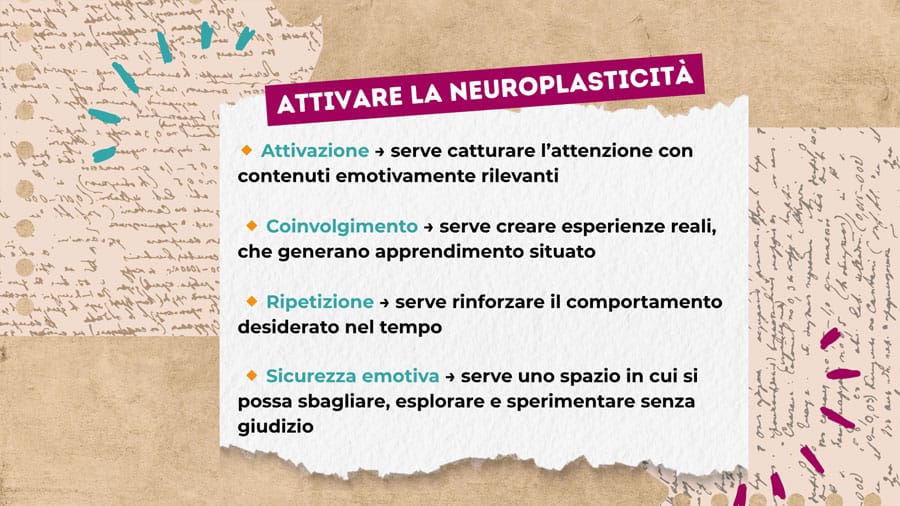
🔸 Activation → grab attention with emotionally relevant input
🔸 Engagement → offer real, contextual, embodied experiences
🔸 Repetition → reinforce the desired behaviour over time
🔸 Emotional safety → create space where people can try, fail, reflect — without fear
In short: the brain changes when it feels safe, involved, motivated and supported.
What we do at MPEC to design brain-friendly, habit-forming training
All our courses — starting with the one on stress management — are built on three core pillars:
🧠 Neuroscience: aligning each activity with real learning mechanisms in the brain
🌀 Evolutionary coaching: guiding experience through awareness, insight, and pattern rewiring
🔁 Habit formation: helping people turn learning into long-term behavioural shifts
In our classrooms, every exercise has a purpose:
not just to explain something — but to create a new emotional-neurological alternative to an old default response.
Yes, the brain can change. So can your team.
You don’t need to be a neuroscientist to lead change.
But you do need to know how to build a learning environment that does more than inform — one that actually lights up new neural circuits.
That’s how we build soft skills that last.
Not through knowledge alone, but through experiences the brain recognises as real and worth repeating.
Neuroplasticity #SoftSkills #NeuroscienceAtWork #WorkplaceLearning #EmotionalIntelligence #StressManagement #LeadershipDevelopment #ExperientialLearning #BrainTraining #CoachingAndDevelopment #HabitFormation #ChangeYourBrain #LearningThatLasts