A journey through neuroscience, psychodynamics, and lived experience
Emotions aren’t a mere “colour” of life: they’re the engine that decides when to accelerate, when to brake, and which lane to take. The distinction between primary and secondary emotions is useful, but it’s a map—not the territory. Here, we take it further: we keep the map in our pocket, look closely at the terrain, and understand how emotions arise, why they morph, and what to do with them—in private life, in therapy, and at work.
What an Emotion Really Is (Without the Mythology)
An emotion is a rapid body–brain response to something that matters. It’s a bundle that includes:
- Signals from the body (interoception: heart, breath, gut)
- Fast appraisals about what’s happening
- An action tendency (attack, avoid, seek contact, freeze)
A communicative display (face, voice, posture)

Crucially, the brain isn’t an on/off switch for emotions, and the amygdala isn’t “the fear centre”. We’re dealing with networks: the salience network (anterior insula, anterior cingulate) flags “this is relevant”, prefrontal areas help regulate and decide, the hippocampus adds context, and autonomic pathways prepare the body. Emotions are processes, not objects.
Primary vs Secondary: Advanced (and Honest) Definitions
Primary: rapid responses, strongly rooted in biology and evolutionary conditioning. They’re “basic” because they emerge early in development and have relatively universal action schemas (e.g., anger → boundary protection; fear → avoidance/activation; sadness → care-seeking; joy → exploration and bonding; disgust → distancing; surprise → orienting).
Think of them as raw energy.
Secondary: constructed, socially shaped emotions (shame, guilt, pride, jealousy, envy, remorse, gratitude, embarrassment). They arise from the interaction between primary emotions, learned narratives (family, culture, school), attachment history, and social goals.
They’re the energy plus the commentary.
Two clarifications to keep us honest:
“Primary” doesn’t mean “pure”, and “secondary” doesn’t mean “fake”. Both are real; they simply operate on different planes (somatic–reactive vs socio–narrative).
The neat list of “six basic emotions” is a useful model, not gospel. Much of emotional experience is predictive and constructed by the brain based on learned patterns, goals, and context.
How an Emotion Is Born: The Brain Predicting the Body
The brain doesn’t wait for facts; it anticipates them. From memory and environment, it generates predictions about:
- What’s going on (meaning)
- What the body will need (allostasis)
- Which action is most efficient (action tendency)
Predictions are confirmed or corrected by interoceptive signals. If the context resembles a threat pattern, the salience network turns the volume up: noradrenaline for readiness, dopamine for motivation, oxytocin if bonding is required. The subjective result? You feel a certain way.
Secondary emotions appear when the mind interprets that primary wave through internal rules: “we don’t raise our voice”, “if I fail, I’m worthless”, “if I’m angry, I’ll lose love”. A primary anger can flip into shame; a fear into jealousy; a sadness into guilt—often in milliseconds.
Primary, Secondary… and Something Else: The Taxonomy You Actually Need
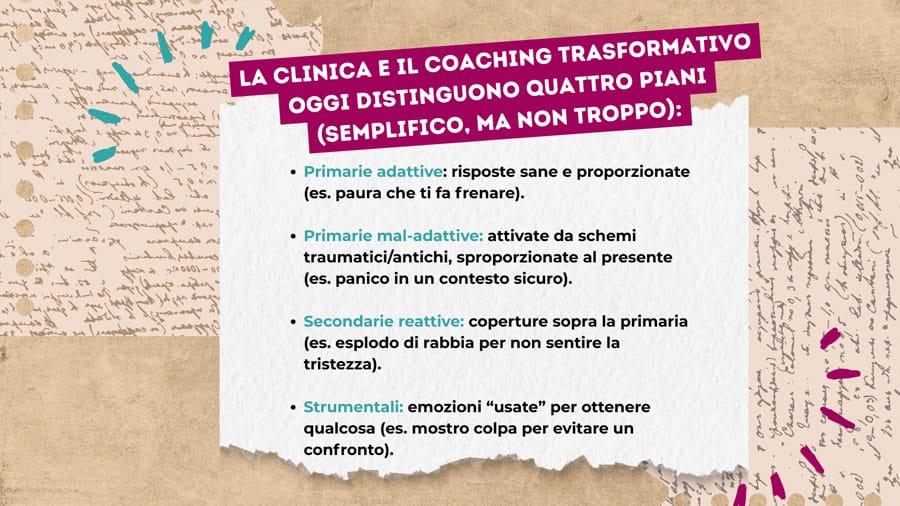
Why it matters:
With instrumental: name the intent and negotiate needs more directly
With primary adaptive: channel it
With primary maladaptive: reconfigure the schema (emotional memory, safety, updating)
With secondaries: drop a level and meet what they’re covering
From Chains to Spirals: How a Primary Becomes a Secondary (and Back Again)
Three real micro-scenarios:
Sadness → Guilt → Overdoing
You lose something important (sadness). A “perform-at-all-costs” culture translates it into guilt (“I didn’t do enough”). Response: do even more. The body empties out.
Antidote: healthy grieving before action.
Anger → Shame → Self-anger
You activate to protect a boundary (primary anger). In your family “anger = bad”, so shame fires. For “losing control” you turn anger on yourself. Result: a draining spiral.
Antidote: name the primary (“I’m protecting something”), repair if needed, but without self-devaluation.
Fear → Jealousy → Control
You fear abandonment (primary, attachment-linked). You label it jealousy and move to controlling behaviours. Short-term calm; long-term corrosion of the relationship.
Antidote: safety dialogue (“I need reassurance, not evidence”).
Emotions vs Feelings vs Moods (Time and Depth)

Training the passage emotion → feeling is what we call integration: from body to word, from impulse to meaning.
Trauma, Attachment, and Culture: Why Some Secondaries Dominate
- Attachment history: if childhood anger shut down a caregiver’s availability, today it may convert into shame/anxiety in milliseconds.
- Trauma: the system stays hyper-predictive about danger. Primaries fire early and strong; secondaries step in to manage the social world—often at your expense.
Culture: what’s “allowed” to feel? In some contexts sadness is banned and becomes chronic irritability; in others, anger is forbidden and turns into passivity or self-discounting.
Practical Tools That Work (Clinic, Coaching, Leadership)
No miracles—method + repetition.
- Emotional granularity: more words, better regulation. Shift from “I’m stressed” to “I’m irritated and also worried about X”. Keep a personal lexicon of 20–30 emotion words you use; update monthly.
- The 90–120-second rule: the physiological wave tends to settle unless you fuel it with catastrophising. Breathe (6–8 slow breaths), scan the body, label sensations, avoid the story until it passes.
- Drop from secondary to primary: when you notice shame/jealousy/guilt, ask: “Which primary am I avoiding?” Tune into the body for 30 seconds.
- Reappraisal without denial: fact → plausible alternative meaning → smallest useful action. Only after acknowledging the body.
- Emotional memory reconsolidation: safe evocation + somatic insight + corrective mismatch → consolidation.
- Awareness – Protection – Healing – Integration cycle: name emotions, set boundaries, address wounds, embed new habits.
Core somatic skills: jaw/tongue release, gentle neck lengthening, foot grounding, visual orienting, urge surfing.
Applications at Work (Because Emotions Move Your KPIs Too)
Decisions: secondaries like shame and pride skew risk. One minute of labelling can prevent costly reactivity.
Feedback: telling protective anger from humiliation keeps feedback from becoming a cold war.
Teams: normalising primary/secondary language builds psychological safety.
Leadership: joy fuels exploration; shared sadness after loss aligns and repairs; well-used anger protects values.
Guiding Questions (Coaching / Self-Coaching)

Common Mistakes to Avoid
- Skipping the body and philosophising: elegant, but useless.
- Dismissing secondaries: they’re an attempt at safety—understand before renegotiating.
- Using reframing to deny: thoughts without touching the wound are make-up.
- Confusing calm with health: many are “calm” because they’re dissociated. True regulation is alive, not flat.
Quick Practical Guide

Repeat. Emotional competence is training, not genetics.
Further Reading
- Models: Paul Ekman; Klaus Scherer & Richard Lazarus; Robert Plutchik
- Neuroscience & construction: Lisa Feldman Barrett; Antonio Damasio; Joseph LeDoux; Jaak Panksepp
- Regulation: James Gross; Kristin Neff
- Shame vs guilt: June Tangney
- EFT: Leslie Greenberg
If your patterns feel old, invasive, or trauma-linked, don’t wait—professional support can achieve in months what may take years alone.
In one sentence: Primary emotions are the wave, secondary emotions are the commentary—learn to feel the wave, understand the commentary, and choose the response so your body stops driving blind and you get back behind the wheel.
Here’s the optimized and unified group of hashtags in English, perfect for social media posts.